Genetics
Foreword
There are so many factors which are involved in breeding genetics. The Breeding Colors section will overview the outcomes of breeding without discussing how. This will allow potential kitten owners to understand which two matings may result in their desired color. Further sections will go into the details of the genetic markers and how they affect the offspring of a mating. To me, this is one of the absolutely fascinating components of breeding and breeding good quality cats.Breeding Colors (Quick Overview)
Color genes are held in the X chromosome. A female is XX, while a male is XY. The father of a cat passes the Y chromosome onto male kittens, while the mother passes the X chromosome, which determines color. This chromosome can be red (X^B) or Black (X^b).
Since there is only one X chromosome in a male cat, it will either be black or red.
Since there are two X chromosomes in a female, there can be an array of possibilty: all black, all red, or mixed. It is this mixed scenario which causes toirtoiseshell coloring
Note: tabby and white are modifications of color, not base colors.
With this information in mind, it can be determined how the parents' colors will influence the kitten colors.
As you can see below, the tortoiseshell mother will produce the broadest range of color variations in the kittens. This is why, as a breeder, tortie's are desireable.
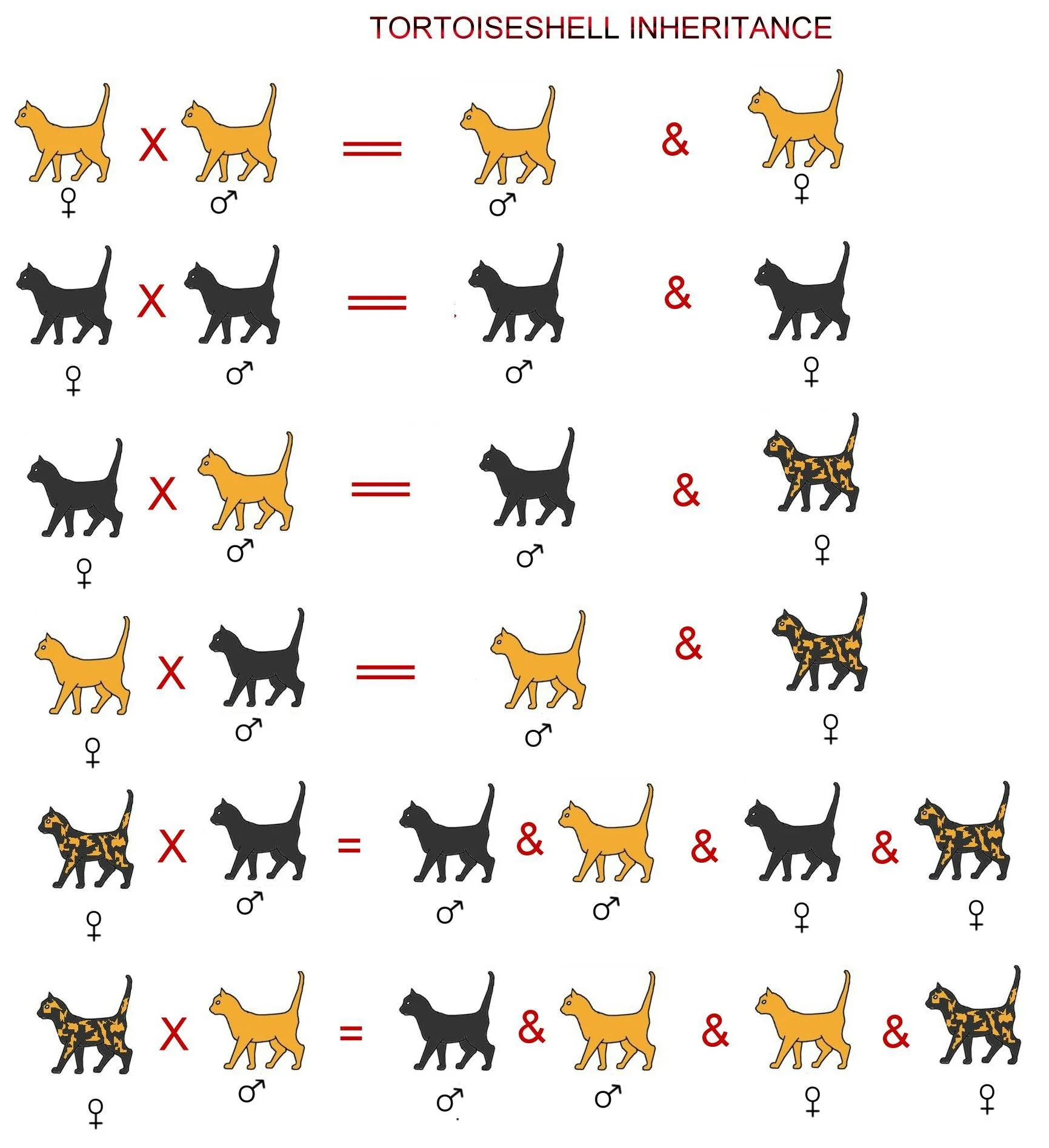
Color Genetics
Agouti (Tabby) vs Non-Agouti (Solid Color)
Agouti is the official name and name of the gene which causes the pattern commonly referred to as tabby. The name of the gene is ASIP (or Agouti Signaling Protein) and is found in many mammals, including humans. In the case of cats, it causes alternating coloring along the length of the hair, resulting in the tabby patterns we commonly see in cats. By contrast, a Non-Agouti cat will have solid coloring along the length of the hair.
The two alleles for ASIP are:
A: agouti &
a: non-agouti.
The gene is autosomal recessive meaning that two changed genes (in this case a) are required to show the recessive pattern.
Going through the permuations it can be shown:
A/A: are two inhereted agouti genes, one from each parent. This results in a banded-haired cat with Tabby Pattern.
A/a: is an example where one parent passes an Agouti gene, while the other parent passes a solid-colored, non-agouti gene. This results in a banded haired cat with Tabby Pattern.
a/a: is the only option for solid-colored cats.
The first (A/A) & last case (a/a) are the most simple examples where it must be a mating of two similar types to produce the required allele pairs.
The middle case (A/a) is where it can be interesting and one of the reason genetic testing in breeding programs can help verify the outcome of matings (although this can also be deducted from the pedigree). If the tabby had A/A and the solid had a/a (which it must), then the resulting cats would all be A/a, tabby patterned. If, however, the tabby parent is A/a, then there could be a mix of tabby and solid depending on which allele the tabby parent passed along. All of the kittens will recieve an a from the solid colored parent while some of the kittens may recieve either the A or a from the other parent, resulting in a litter mixed with A/A and A/a.
At RebelSkog we focus on agouti-colored cats. Although, as you will see below, there are a lot of variations when it comes to agouti.
Solid Colors
Now, even though I used the word "color" in the above section, the ASIP gene does not actually control the color, only the distribution of pigmentation.
Regardless of ASIP type, the color a cat may be is the same. For example, it is possible to have either a red tabby or a red solid-colored cat
The four base color types (I am sure the number four can be debated, but for simplicity) are: Black, Chocolate, Cinnamon, & Red. Black can also be called "Brown" but is not the same as chocolate. Amber is a special fringe case in Norwegians, and white is a covering of color not a base color.
These colors can be modified. See the next section on Dilution.
Dilution
Dilution is now where we throw some pepper into the mix to make the colors, the same, yet different.
The results of dilution are that Black turns to Blue, Chocolate to Lilac, Cinnamon to Fawn, and Red to Cream.
The two alleles for Dilution are:
D: Wild Type (Full Color) &
d: Dilute.
The gene is autosomal recessive, meaning that two changed genes (in this case d) are required to show the recessive pattern.
Going through the permuations it can be shown:
D/D: Do not carry dilution.
D/d: full colored but carries dilution.
d/d: are a dilute-colored cat.
At RebelSkog both Liv and Garnet carry a dilution gene. Since Deuces and Norton do not carry dilution, we will not have dilute colors (blue & cream) at this time.
White
The white coloring (or more acurately covering) in cats is an extremely in-depth and fascinating topic.
The three alleles for White are:
N: Non-White,
DW: Dominant White, &
Ws: White Spotting.
The gene is autosomal dominant8 meaning that a single copy of the gene (in this case DW) will show the white pattern. White can present the full range from only have white paws and chest (like Norton) or being full white (like Roewe).
Going through the permuations it can be shown:
N/N: No White
N/DW: Will have white.
DW/DW: Will have white.
N/Ws: Will have white.
Ws/Ws: Will have white
DW/Ws: Will have white.
Now that the genetic permuations are understood, let's make it more confusing. The kitten, RebelSkog's Rowen, pictured below is genetically a black tabby. How can this be!!!! Well, the white is covering it up. Oftentimes full white kittens are born with a spot of color on their head, which slowly disappears as they age.
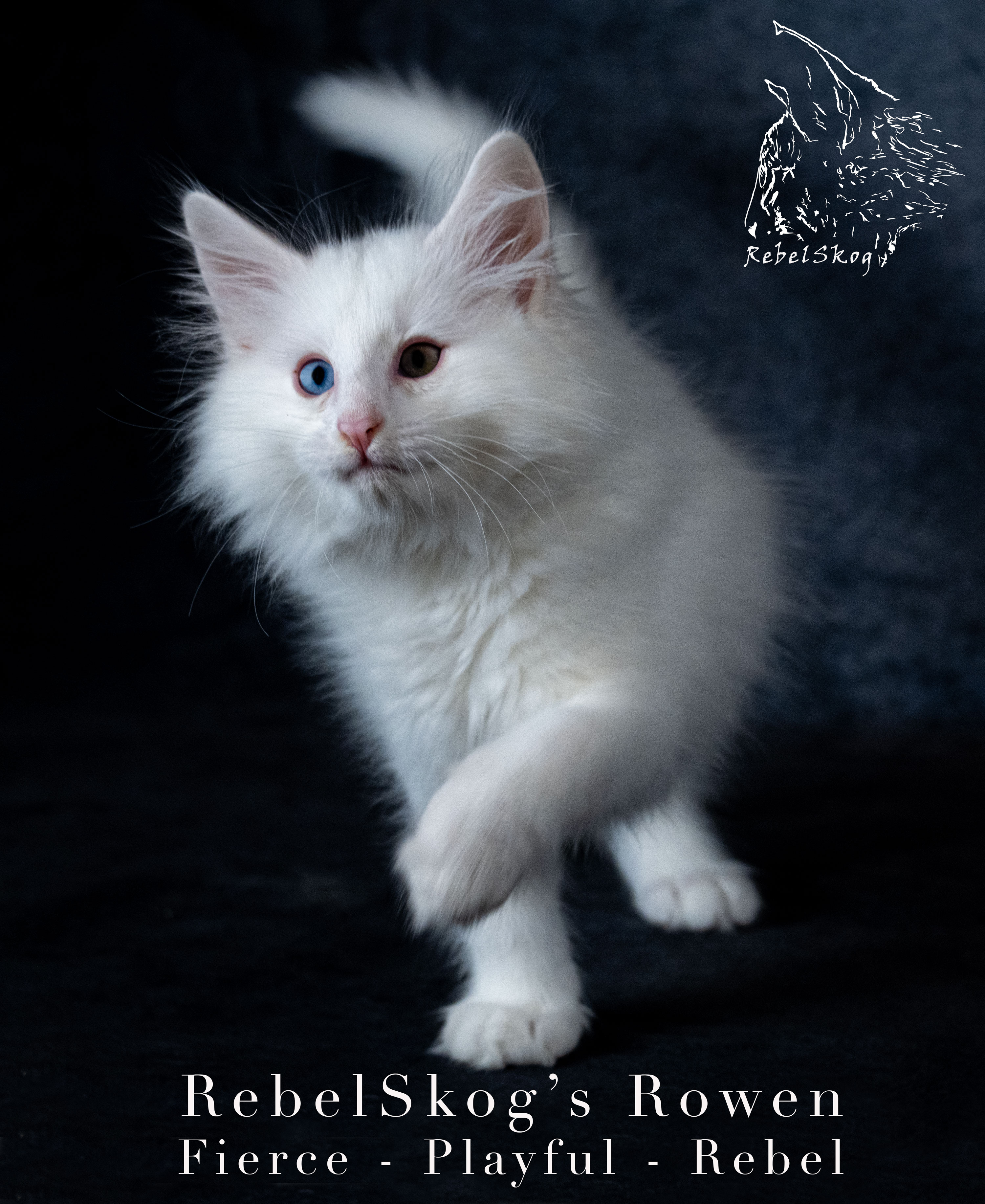
Breeding of white cats must be done very carefully to avoid health problems. It has been found that breeding two white cats with Dominant White genes causes a high likelihood of health issues. The cat association FIFe even has a provision in their association not allowing this of their members. At RebelSkog we also follow this principle, which is why for some of our cats you will see specialty genetic tests to determine the alleles for our breeding matches.
Another interesting issue is that if a white cat has a blue eye, it is because the white is covering the pigementation of that eye. There is a high probability of deafness in the ear on the same side as the eye. To determine this, there is a test (B.A.E.R) which can be performed to determine if the ear canal can pass sound. Both Rowen and Roewe have had this test performed and are full hearing.
White cats are regal and gorgeous, and the genetics fascinating
References
1Mayo Clinic Autosomal Recessive Inheritance Pattern2UC Davis Agouti
3Cat World Types of Tabby Patterns
4UFL Vet Medicine Coat Colors & Patterns
5Wiki Cat Coat Genetics
6UC Davis Dilution
7The Genetics of Calico Cats
8Autosomal Dominant Inheritence
9Labgenvet Universite de Montreal